


If you’ve been following our recent blog posts closely, you’ll have learned about the value of Customer Experience (CX), how it’s becoming the new economic differentiator, the ways business owners can meet shifting customer expectations, and how an irresistible CX can truly set you apart! Assuming that you’ve taken all of this to heart, how can you begin to reflect this sensibility in your marketing efforts?
In a survey with 15,000 customers, PWC found that 73% of customers cited Customer Experience as an important factor in their purchasing decision. So why is it that many companies fail to align their customer brand promise in marketing initiatives with their CX? In this article, we’ll delve into the ways businesses can avoid this misalignment, reasons businesses should integrate CX into their marketing strategies, and a few immediate actions your company can take to stay ahead of the game.
Be A Market Trend Leader
95% of a customer’s purchase decision-making happens subconsciously. You’re likely surprised by how high that percentage is. While we’re not suggesting that you completely overhaul your marketing tactics tomorrow, it’s important to consider how large of an impact an online review or a friend’s recommendation could have on a future customer – whether they’re conscious of its influence or not.
Still not totally sold on changing your company’s marketing approach? Here are three reasons to change your mind:
- It’s free: Now there’s a caveat to this. Word of mouth marketing is free if your customer’s experience was positive and memorable. Otherwise, you’ll be spending big dollars to change the narrative and reverse the damage caused by a negative customer experience. Customers tell an average of 9 people about a positive customer experience, so to leverage “free marketing” effectively, your company needs to outperform on genuine connections and meaningful actions that are so impactful they have major word-of-mouth potential.
- Unsolicited opinions: What people say about a company online has become the single biggest influencer on that company’s brand image. In fact, 66% of global consumers indicated they trust online reviews from strangers when making purchasing decisions. As a result, what your past customers say about your CX stays online forever and influences your future customers. That raw and unedited language can either hinder a purchase or hyperactivate it!
- More bang: Have you ever wondered how many customers come to your business as a result of your marketing efforts? Your answer should be “not enough!” Consumer trends are constantly changing and if your marketing tone and tactics don’t adapt in real-time, your marketing efforts may be unintentionally alienating the very customers you are trying to attract. It is crucial that your company understands its customers’ sensibilities and reflects these in your communications. By doing so, you’ll be able to improve your company’s CX, reach more potential customers, and drive revenue without changing your marketing budget.
By doing some of the tangible things outlined below, you’ll be steps ahead of your competitors and frankly, your customers will take notice when your company’s strategy focuses on improving their experience.
How Can You Integrate CX Into Your Company’s Marketing Strategy?
Incorporating CX into marketing strategy doesn’t necessarily mean that a company has to do a full 360 and redevelop its marketing tactics and budget allocations. Just by virtue of bringing a customer experience orientation to your current efforts, you can begin to critically filter your initiatives and refine your implementation.
Companies can immediately take these three simple steps to integrate CX and give them a leg up in driving sales, growth, and brand loyalty.
1. Understand Your Customer
How can you market effectively if you don’t take your customer’s perspective into account? Understanding your customers goes beyond providing a generically “good experience” for everyone and delves into the nitty gritty of what truly delights your customers and sparks emotive reactions. Personalization is the new key success factor, with 63% of consumers agreeing that personalization is now part of the standard of service they expect. As a result, a personalized focus in both marketing and customer touchpoints is an accessible application of CX integration that will allow your business to tap into potential synergies. This can be as simple as greeting a regular customer by name or ensuring that your remarketing efforts acknowledge a past purchase by a customer who has already bought your product.
If you’re wondering how to know exactly what your customer desires, we challenge you to consult the customer metrics your business keeps track of. Do these metrics give you insight into building out accurate customer personas for your customers? If your business doesn’t collect customer data or feedback, perhaps now would be a good time start. Or, to make things even simpler, just ask your customers! According to a survey done by Brightlocal, 68% of customers will leave a review when asked by a local business, so why not just ask?
2. Focus On Alignment
Your marketing team is likely at the core of drawing customers to your business. The marketing team offers customers a promise of excellent products or services and yet, more often than not, this team has no role in the follow through on this brand promise. In fact, only 27% of companies’ customer experience teams actually report into the marketing division. This disconnect can lead to customer letdown and tarnish your company’s brand image.
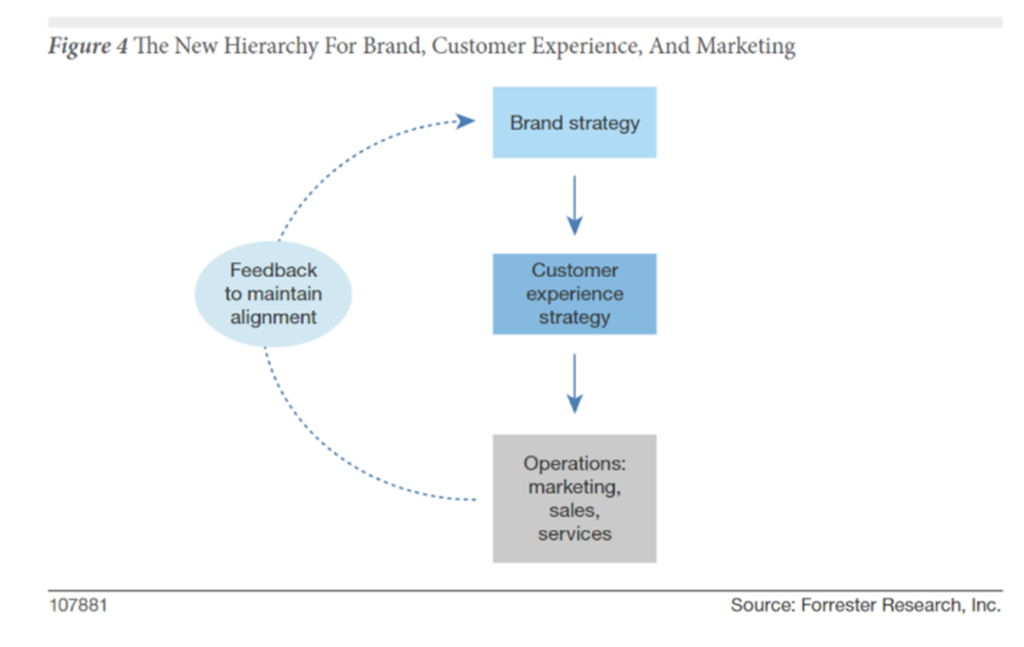
This organizational model presented by Forrester, integrates the brand, customer experience, and marketing teams under one structure to maintain alignment between all streams and teams. While this cross-functional model may be a longer-term organizational design consideration for your company, in the short-term, encouraging open communication between teams will foster better alignment and ultimately lead to a better experience for your customers.
3. Do Proact; Don’t React
Rather than thinking about your brand’s reputation reactively, we want to challenge you to consider your company’s reputation proactively. A company’s brand reputation is entirely in the hands of its customers and no amount of marketing spending can control the voice of the customer. As such, the only way that you can influence the voice of your customers is through the experience, good or bad, that your company provides.
The instantaneous nature of social media provides huge potential for far-reaching marketing initiatives, but can also ruin a company’s reputation. Less than 24 hours after a video of a passenger being dragged off a United Airlines flight went viral, the company lost $1.4B in value, and the public’s opinion of the airline was catastrophically shattered. Nine years after this incident, many of the airline’s past and potential customers continue to harbour a negative judgement of this airline’s lack of regard for their customers.
If a negative customer experience can ruin a brand’s reputation, why don’t more companies focus on a positive customer experience to build a great brand reputation? Because it takes discipline. Here is some provocative thinking: Warren Buffet said, “It takes 20 years to build a reputation and five minutes to ruin it. If you think about that, you’ll do things differently.” Again, while you can’t force a customer to leave you a good review, the experience they have with your business and how they feel after the experience is entirely in your hands.
More than a fad
Some business leaders may view Customer Experience as a new marketing trend, but with 80% of companies expecting to compete primarily on CX in 2020, there is no time to be idle. Considering the intersection of Customer Experience and Marketing provides businesses with huge potential for finding untapped synergies and ultimately, becoming more relatable to their customers.
Not sure how to take your Customer Experience to the next level and looking for a little extra help? At the XLAB, we work with bold leaders who aren’t afraid to lead a change to create amazing experiences for their customers. Visit https://stackdxlab.com/ for more information on how we can work together to accelerate your customer experience.